


“Avant-Garde is a Military Metaphor”, so where are we headed? A review of 180 Studios Paradigm Shift
Stefanos Carras

“Follow the light at the end of the tunnel,” I am told as I look for the entrance to Paradigm Shift, the new moving image exhibition at 180 Studios. Did I experience a figurative death, resurfacing from this subterranean maze with my mind renewed? Unfortunately, I did not. Beginning strongly with Mark Leckey’s Fiorucci Made me Hardcore, the raw energy of British dance sub-cultures traces solidarity and ecstasy in collective movement. But it also foreshadows that, in this exhibition, there will be a lot of different tunes to dance to. Without a clear spine, Paradigm Shift includes must-see works that revolutionised moving image culture from the ‘70s onwards, as well as works that seem to have no interest in being radical. It is unclear which paradigm shift we are meant to witness, since the exhibition as a whole remains tame. The most ground-breaking of the films shown have to speak for themselves, with no support from a clear exhibition narrative.
The large range of works at least allows the visitor to trace some general themes that film has explored in the last decades. Three stand out, the first being materiality and form. By showcasing varied formats from Super-8 and early digital all the way to AI, the significance of texture in the moving image is made apparent. Coupled with a range of forms beginning from found images and documentary works all the way to a fake reality show, one gets to understand the full matrix of possibilities investigated by moving-image artists.
Paradigm Shift also shows the unique ability of film to immortalise other art mediums and spaces of expression. Dance is captured in Gillian Wearing’s public performance experiment. Clay is Tremaine Emory’s focus as an homage to a memory-laden place. In Studio, Derek Jarman’s own workspace and the art within it are used as raw material for a meditative film. Finally, Foday Dumbuya’s work sheds light on the unifying power of African football cultures. In all these cases, film reveals itself as a powerful tool to make statements using existing materials and cultural phenomena.

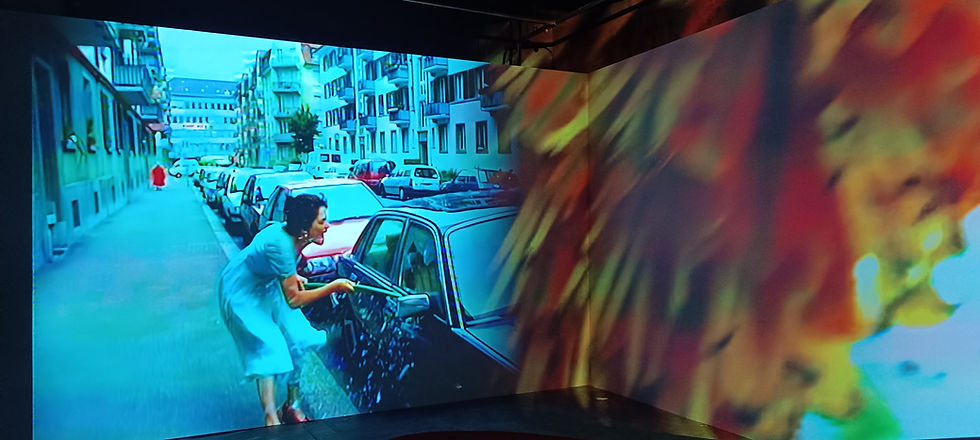
The last overarching theme concerns moving image as a mode of societal critique and self-empowerment. This function of film is obvious with Pipilotti Rist’s brilliantly sharp Ever is Over All. This piece cherishes rage as a woman smashes car windows with a fake red hot poker flower, subverting the standards of femininity with ‘flowery,’ graceful violence. Similarly, Wearing’s Dancing in Peckham is a still-camera documentation of herself claiming public space for the sake of self-expression. On a contemporary note, JulianKnxx’s …?M claims space from the modern street to give life to Caribbean and West African Masquerade traditions. These ‘spirits’ filmed in slow-motion and accompanied by a poetic monologue appear to embody eternal truths that contrast deeply with the pace of contemporary existence.
In this exhibition, 180 Studios claims to be “Looking back to look forward…” However, it seems like some of the contemporary works chosen make no strong statement for the future. The viewer stands before Meriem Bennani’s two animated lizards without knowing what paradigm this work is supposedly shifting. The fact that this animation was released as a series on Instagram during lockdown is not a paradigm shifting event. Instead, it is a common use of contemporary culture production as well as a reminder that Meta (Instagram’s parent company) funds this exhibition.
Nevertheless, it must be noted that at least two of the contemporary works provide strong criticisms of the current political landscape surrounding art and fashion. Sophia Al Maria’s Tiger Strike Red focuses on an
18th century Indian flute automaton in the shape of a tiger killing a British soldier. Exploring the V&A collection with childlike lack of restraint and caustic humour, the film discusses the deeply important matters of colonial rule and colonialist museum aesthetics. The lecture-style monologue is frequently interrupted, perhaps as a reminder of the difficulty of progressing away from the colonialist paradigm. With a highly stylised visual identity, the colour red cuts through as a double-edged metonymy for British rule and blood.

Telfar brings a similarly powerful piece responding to the race dynamics that are painfully present in the fashion industry. Dissatisfied with the façade of ‘inclusion’ that became a superficial trend, a 24-hour live- stream channel called TELFAR TV was constructed as a space for countering structural power in the industry. Paradigm Shift includes an episode from this channel called ‘New Models’: a fake model-casting reality show, with an expert spectacle television style. Telfar makes it clear that they are not looking for models, but for a space that responds to systemic oppression through collective re-definition and action. After calling on one of the participants to define what the new models are, the show organically transformed itself into an electrifying chant of solidarity with Palestine and an opposition to highly individualistic capitalism. The ‘new model’ screams: “Avant-Garde is a military metaphor; the goal is to desert it!”
But the exhibition leaves it at that, and there seems to be no paradigm shift to look forward to. We are left with the tantalising thought of a new way of being, but not enough works that help the mind of the contemporary viewer to imagine it. Surprisingly, even the works from the 1970s-2000s are not contextualised in a way that explains what a paradigm shift really means in the first place.
It is perhaps naïve to expect a radical critique of contemporary life from a show made in collaboration with Ray Ban and Meta. From the moment a space decides to partner with goliaths of capitalism, we can expect no more than a superficial critique of the systems that sustain them. Fortunately, a few important and powerful works get to make their own statements through Paradigm Shift.


