


Colour inhabiting sculpture – Hepworth in Colour at The Courtauld Gallery
Updated: Aug 14
Dana Aben

"In a way my colour has been accepted but never understood," Barbara Hepworth once remarked. It is this statement that forms the conceptual foundation of Hepworth in Colour at The Courtauld Gallery, the first exhibition devoted entirely to colour in the artist's work. Co-curated by Dr Alexandra Gerstein and Dr Stephen Feeke, the exhibition seeks not simply to highlight a neglected aspect of Hepworth's practice, but to fundamentally reconsider how her sculpture has been understood. Rather than treating colour as an incidental addition to otherwise monochrome forms, the exhibition argues that it was central to Hepworth's conception of space, landscape, and abstraction.
The premise emerged from an observation made by Feeke during his research. When Hepworth left London for Cornwall in 1939, just days before the outbreak of the Second World War, she chose to take with her a sculpture incorporating colour. Of all the works she might have saved, this was the one she selected. The exhibition presents this seemingly small detail as evidence that colour was not a peripheral experiment but a fundamental concern that accompanied her throughout her career.
The opening galleries focus on the years surrounding the Second World War, a period in which Hepworth's sculptural production was severely restricted by shortages of materials and the demands of family life. Unable to work at the scale she desired and often lacking access to materials, she increasingly turned to drawing and small plaster studies. Rather than presenting these works on paper as secondary to her sculpture, the exhibition positions them as laboratories of experimentation. Hepworth's crystalline "drawings for sculpture" reveal an artist testing relationships between colour, line, and form long before she found expression in three dimensions. Looking closely, her intricate structures and layered pigments undermine any notion that they were quick preparatory sketches. Instead, they emerge as works of remarkable complexity in their own right.
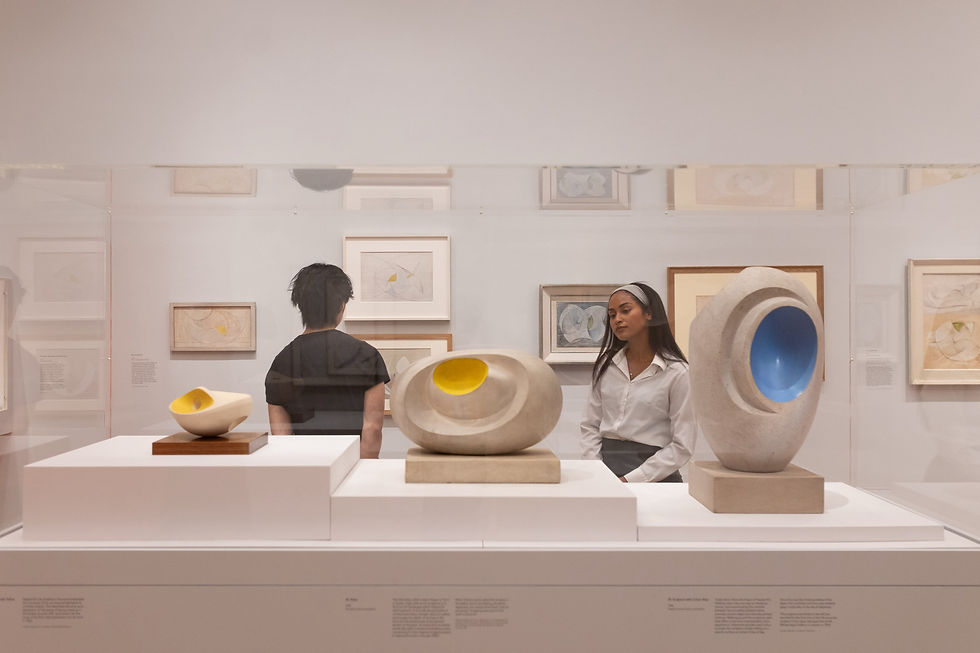
Alongside the drawings in the first room is Sculpture with Colour (Oval Form), Pale Blue and Red (1943), recently acquired by The Hepworth Wakefield and displayed here as an early indication of the artist's growing interest in colour. The work marks a breakthrough in Hepworth's use of colour, bringing together piercing, string and painted surfaces within a carved wooden form. The pale blue interior immediately evokes the sea and sky of Cornwall, while the red accents create moments of visual tension. What is striking is that these elements work together conceptually, creating what we now recognise as a quintessential Hepworth. The colour does not appear decorative; instead, it seems to inhabit the sculpture itself, creating the illusion that colour resides within the material rather than upon its surface.
This question of how colour could coexist with Hepworth's commitment to truth to materials is one of the exhibition's most compelling themes. As Gerstein told press, Hepworth was "not a stickler for pure rules." Rather than concealing the natural qualities of wood or stone, she developed a method of painting interior hollows and concavities. The result is that colour appears to emerge from the core of the sculpture, preserving the integrity of the carved object while simultaneously transforming our experience of it.
This approach becomes particularly evident in Pelagos (1946), widely regarded as one of Hepworth's masterpieces. Its pale blue interior and carefully tensioned strings evoke the bay at St Ives without directly representing it. The sculpture does not depict the landscape so much as embody the sensation of inhabiting it. Nearby, Wave (1943–44) similarly demonstrates how colour functions as a sculptural device. The blue-painted recesses create a sense of depth that extends beyond the physical limits of the object, suggesting caves, water, and vast expanses of sky.

Throughout the exhibition, colour repeatedly operates as a means of expanding sculptural space. Feeke's discussion of Hepworth's fascination with deep blues is particularly illuminating in this regard. For Hepworth, blue could suggest both the depths of the sea and the infinite reaches of the cosmos. This duality is evident in the series of Sculpture with Colour (Deep Blue and Red) works, brought together here for the first time. Their saturated interiors appear almost limitless, transforming carved hollows into portals that oscillate between the geological and the celestial.
The second gallery space brings together a remarkable group of works that have travelled from collections across the UK, Europe, North America and beyond, many of which have not been displayed alongside one another for decades. Particularly significant is the reunion of Eidos and Eos. Eidos, first shown in Hepworth's 1954 Whitechapel Gallery retrospective—where the artist remarked that “nobody talks about my use of colour”—subsequently toured North America before entering a public collection in Australia. Its inclusion here marks its first return to London since 1954. Eos, with its striking blue eye, followed a similar trajectory, touring North America before entering a private collection and eventually finding a home in Hong Kong. Their presence at The Courtauld offers a rare opportunity to view these works afresh and to appreciate the dialogues Hepworth established between two-dimensional and three-dimensional forms, as well as between contrasting colours and tonalities. Their vibrant yellow and blue interiors demonstrate the increasing confidence with which Hepworth integrated colour into her sculptural language. These are works in which colour no longer appears experimental but fully resolved, functioning alongside piercing, carving, and stringing as one of her principal artistic tools.
The display also highlights a less familiar aspect of her practice: the increasingly expressive drawings and paintings of the 1950s, shaped by her engagement with American Abstract Expressionism and French Tachisme. These experiments in colour and gesture would, in turn, inform works such as Sea Form (Porthmeor), whose richly coloured surface demonstrates the continuing importance of painterly effects within her sculptural practice.
Yet perhaps the most surprising aspect of Hepworth in Colour is the extent to which art history has overlooked this dimension of her work. As Feeke notes, colour received remarkably little attention when many of these sculptures were first exhibited in the 1940s. Even Hepworth herself expressed frustration that critics continued to discuss her carving while ignoring her use of colour. The exhibition therefore feels less like a discovery than a correction. It asks why generations of scholars have privileged form and materiality while overlooking a feature that was plainly visible all along.
The exhibition succeeds because it does more than identify a neglected aspect of Hepworth's practice. It demonstrates that colour was fundamental to her sculptural thinking, shaping her engagement with landscape, space, and abstraction throughout her career. By placing sculpture, drawing, and painting into dialogue, Gerstein and Feeke reveal colour as a thread running through Hepworth's entire practice.
Nearly eighty years after Hepworth first complained that her colour had not been understood, Hepworth in Colour finally gives it the attention it deserves. In doing so, it offers not only a fresh perspective on a canonical artist, but a compelling reminder that even the most familiar figures of modernism can still surprise us.
The exhibition's argument is subtly reinforced by the accompanying display, Hepworth and Nicholson: The Hampstead Studio Photographs, presented in the Courtauld's Project Space. Drawn from the Courtauld's extensive archive of photographs by Paul Laib, the display offers a rare glimpse into the shared studio that Barbara Hepworth and Ben Nicholson occupied in Hampstead between 1932 and 1939.
Far from functioning as documentary records alone, Laib's photographs reveal the studio as a site of continual experimentation. Sculptures, paintings, pebbles, plants, tools and found objects are arranged and rearranged throughout the images, creating carefully orchestrated compositions that blur the distinction between workspace and exhibition space. The photographs demonstrate the extent to which Hepworth and Nicholson's practices developed in conversation with one another. Nicholson's reliefs and Hepworth's sculptures frequently appear side by side, their formal similarities becoming increasingly apparent as both artists moved towards abstraction.
Particularly striking is the attention Laib pays to surface and texture. His photographs possess a sculptural quality of their own, lingering over carved forms and subtle material contrasts. The display reminds visitors that the emergence of abstraction within British modernism was not solely the result of individual artistic genius, but of a rich network of collaborations, shared spaces, and creative exchanges.
Viewed alongside Hepworth in Colour, these photographs provide an invaluable context for understanding the artist's development. They reveal the domestic and intellectual environment in which many of the ideas explored in the exhibition first took shape. If the main exhibition demonstrates how colour became integral to Hepworth's sculptural language, the photographs show a glimpse into the world from which that language emerged.


