


The Price of Proof: Amalia Dayan on Auctions, Authority, and the New Logic of Value
Yuval Aluf

Just off Fifth Avenue, New York City, where midtown traffic folds into the usual afternoon rhythm of horns and hurried appointments, the entrance to Lévy Gorvy Dayan offers an abrupt shift in tempo. Inside the townhouse, the city's noise gives way to something quieter: white panelled walls, a marble staircase curling upward, a checkered floor whose muted reds echo the deep crimson of Domenico Gnoli's paintings hanging just beyond the foyer.
Moving through The Adventure of Domenico Gnoli while waiting for Amalia Dayan, partner at Lévy Gorvy Dayan and a former specialist at Phillips and Gagosian, I find myself slowing down. Gnoli's paintings isolate fragments of everyday life detached from their context and usage: a strand of hair enlarged into a landscape, the crease of a bedsheet rendered with surgical precision, the surface of an apple divided into exact symmetry. Familiar, but suspended, held still long enough to be reconsidered. It is a gesture entirely at odds with the market it is surrounded by. And it is, it turns out, exactly the right place to think about what that market has been getting wrong and what it is now, haltingly, learning to value.
The Adventure of Domenico Gnoli is the largest presentation of the artist's work in the United States in more than five decades, the first major commercial showing since his celebrated 1969 debut at Sidney Janis Gallery, the very show he died four months after. That Lévy Gorvy Dayan chose this particular moment to mount it is a wager: that a market which spent the better part of a decade rewarding speed and novelty is now ready, even hungry, for something that requires more of it.

Amalia Dayan has watched those cycles from an unusually advantaged position. Her career began in a gallery that doubled as an auction house, before she arrived in New York for a master's at NYU and found her way, through internships, to Jeffrey Deitch, where she simply "fell in love with gallery life." A tenure followed at Phillips, where she worked as a contemporary art specialist under Daniela Luxembourg, then Gagosian, then her own gallery, and now, four years into the partnership that became Lévy Gorvy Dayan. Each transition taught her something different. "Knowing what you don't want to do," she says, "is a key aspect of understanding what you do want to do." What she kept returning to, across all of it, was the gallery, and it is perhaps her time moving between galleries, auction houses, and private dealing that has made her especially attentive to a single structural fact about how value is made."Auction is public," she says. "Private sales are private. Auction prices are the only public data we have."
The observation sounds simple. It is not. In a market where the overwhelming majority of transactions are negotiated privately, values undisclosed, terms confidential, relationships carefully guarded, the auction house performs a function that goes well beyond selling. It generates the comparables on which all other values quietly depend. A private dealer pricing a work, a collector deciding whether to sell, an estate weighing an approach: all of them are triangulating against a record they had no hand in creating. The auction does not merely reflect the market. It authors it. That authorship travels. "If a Jean-Michel Basquiat sells for a lot at auction," Dayan explains, "it affects the value of other Basquiats privately." What sounds like an observation about sentiment is actually a description of a structural mechanism in which a single public result reorganises an entire field of private expectation, reshaping negotiations that were never formally related to it. The auction room is less a marketplace than a lighthouse: its signal reaches far beyond the transactions it directly illuminates.
This authorship has grown more consequential as the distance between public and private markets has widened. More than 29,000 works changed hands through online-only auctions in 2024, nearly 190% above pre-pandemic volume. And yet Christie's and Sotheby's alone accounted for 62% of postwar and contemporary sales by value in 2025, while representing just 6% of total transactions. The market has expanded its reach while concentrating its authority. Almost anyone can enter; very few institutions can confer the kind of authority that actually moves private prices. And in a contracting market, global fine-art auction sales fell to $10.2 billion in 2024, down 27.3% year-on-year. The question of who holds that authority, and how it is conferred, has grown sharper than ever.
"The walls are full," Dayan says. "There's too much art."
She is not simply describing saturation. She is describing a particular kind: the residue of a speculative cycle that treated visibility as sufficient proof of value. During the post-pandemic boom, artists could rise fast and sell faster; the market rewarded momentum over meaning, novelty over depth. What it has left behind, now that the cycle has turned, is a glut: work that entered the market on the strength of appetite rather than argument. Ultra-contemporary sales fell 37.9% in 2024, following a 25.1% contraction the year before. The number of ultra-contemporary works selling for more than $1 million dropped from 335 in 2022 to just 117 three years later. The walls, in other words, are full of work produced for a market no longer functioning in the same manner.
Compounding this is a generational reckoning Dayan identifies. The collectors who drove the market for the past two decades, in her reading, are sunsetting: buying less, selling more, and not being replaced at the same rate. "Collecting is usually cyclical," she says. "It's not something you do at the same volume and passion for usually more than ten, fifteen years. And then you slowly sunset." Their children, she adds, are not necessarily picking up where the parents left off. The average number of buyers per gallery fell to its lowest level since 2021 in 2024, with the sharpest decline among smaller businesses, down 40%. Who the next generation of serious buyers will be remains genuinely unclear, though Dayan suspects they may emerge from finance and technology. The intuition is plausible; given that economists forecast $84 trillion in assets will change hands over the next 20 years, with millennials set to inherit $27 trillion and Gen Z a further $11 trillion, according to Bank of America. Demographic shifts within the market are already visible; millennials and Gen Z already account for roughly a third of buyers and bidders at the major auction houses, more than double their share five years ago. "The flight for certainty feels very real right now," she agrees with me, a market not just contracting, but waiting.
What it appears to be demanding in the meantime is justification. "Quality matters now more than ever." It is not, she insists, simply a matter of price or critical fashion. "I do believe that quality is objective," she says, while conceding how difficult it is to define. For her, it lives in depth: a work's relationship to art history, the knowledge embedded in its making, the density of ideas it can carry under sustained scrutiny. Discussing Basquiat, she points not only to market enthusiasm but to the artist's engagement with Cy Twombly and Jackson Pollock, his awareness of what preceded him, his position within a longer argument. "Even intuitive knowledge," she says, "is key in the quality of the work." Quality, on this reading, is what remains when the season changes: not a judgment of taste, but a test of endurance.
This shift has changed what galleries are now expected to do. In a speculative market, visibility was often enough a fast show, a fast rise, a fast sale. In a more cautious one, visibility requires justification. "Doing less is definitely more," Dayan says. "Less shows, but great shows, a smaller roster… deeper relationships." The restraint is not modesty; it is a response to real pressure. Art fairs now account for 35% of dealer sales, up from 31% the year before, not because galleries are necessarily thriving within them, but because an increasingly concentrated market has made a small number of global fairs harder to avoid.
That logic extends to what the gallery agrees to represent in the first place. Before committing to an artist or estate, Dayan says the essential question is: "What can we bring to the picture?" Not what is the opportunity, not what is the demand, but what can the gallery itself add, in terms of knowledge, relationships, institutional pathways, and sustained belief in the work. It must, she says, begin with passion. "But sometimes you're passionate, and you can't really deliver what this estate needs." The combination, when it works, is what she calls "complementary", and she means it almost in a chemical sense: two things that activate each other. "To make magic," she says simply.
For Dayan, the question of what a gallery can add is also what the market has stopped supplying on its own. In a boom, artists are pulled into the spotlight before their case has been fully developed. The work seems to arrive before the knowledge does. What galleries like Lévy Gorvy Dayan are now being asked to do, and what Dayan seems to understand as their deepest function, is to reverse that sequence: to build the case first and let the market follow.

Which brings us back to Gnoli, and to what his return actually represents. Dead at 36, prolific but contained, institutionally respected but never absorbed into the speculative cycles that made and unmade so many reputations in the decades that followed, he is precisely the kind of figure the current market is positioned to rediscover. Dayan resists framing the exhibition as a direct response to market conditions. It was, she says, "curation out of love": a show built from fifteen years of working with his paintings, from accumulated knowledge of his place in postwar art, and from a recognition that younger artists have increasingly returned to his strategies of stillness, isolation, and obsessive formal precision, making his work newly legible within a contemporary conversation it never quite entered during his lifetime. "It just felt like the right time to bring it back," she says. "The timing felt right." The result is not a revival but a re-justification: a body of work repositioned within a discourse that has, belatedly, caught up with it.
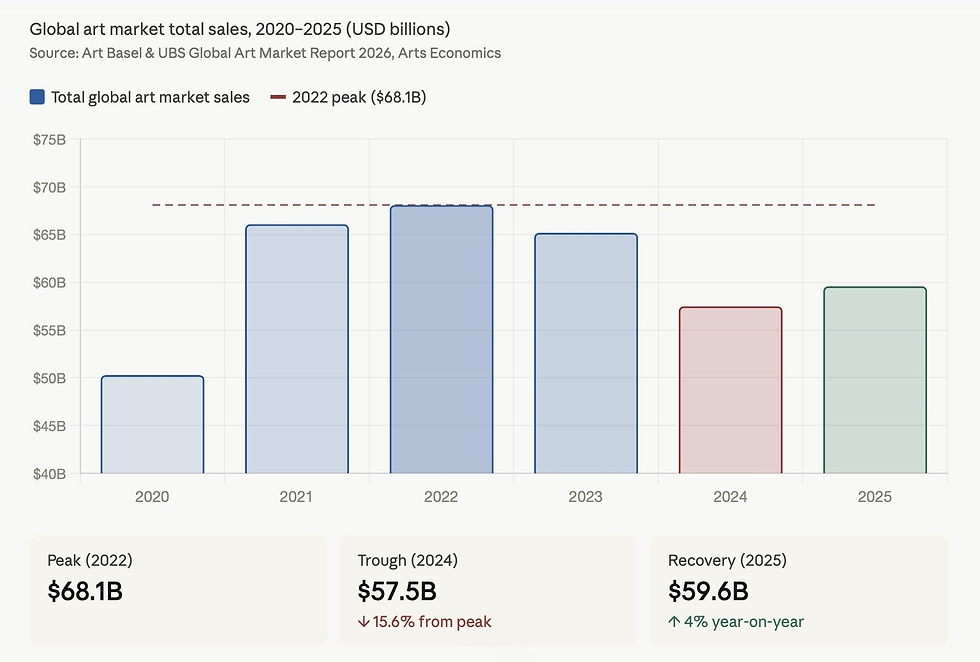
In 2025, the global art market returned to growth, rising 4% to $59.6 billion, with combined auction sales up 6%. But private sales declined by 5% over the same period, a gap that is more than statistical: it suggests that confidence has returned first to the verifiable, the documented, the public. The market has recovered, but on its own terms, according to criteria that look very different from those of the previous cycle. There is one complication Dayan allows, almost in passing, that lingers after the conversation ends. Asked whether curation shapes art history or whether the market does, she is unequivocal: "It's totally interlinked. It's impossible to separate." Even museums, she notes, are not immune to the fact that their blockbuster programming is shaped, in part, by what the market already values. The thesis that quality now supersedes hype is real, she believes. But quality and market have never been fully distinguishable, and anyone who claims otherwise is selling something.
What the current moment demands, then, is not purity; it is proof. Proof that a work belongs to a longer conversation, that a gallery has the knowledge to make that case, that an artist's ideas can hold up under scrutiny rather than simply under conditions of scarcity. If the last cycle rewarded speed and novelty, this one rewards endurance, depth, and the willingness to wait for the right moment. The question is no longer what the market can accelerate, but what can withstand the test of time.
Statistics and market data cited in this article are drawn from the following reports: Art Basel & UBS Global Art Market Report 2026, authored by Dr Clare McAndrew of Arts Economics. Published March 2026. Artnet Intelligence Report: The Year Ahead, 2025. Published by Artnet News in collaboration with Morgan Stanley, March 2025. Data on generational wealth transfer and collector demographics is drawn from the Artnet Intelligence Report 2025, citing Bank of America research, and from interviews with Christie's president Anthea Peers, published within the same report.


